AWS $200 Free Credits and Claude on Amazon Bedrock: How to Claim Them and What They Cover (2026)
Learn how to claim $100 in AWS credits at sign-up and $100 more from five activities, then call Claude on Amazon Bedrock and check whether your credits paid for it.
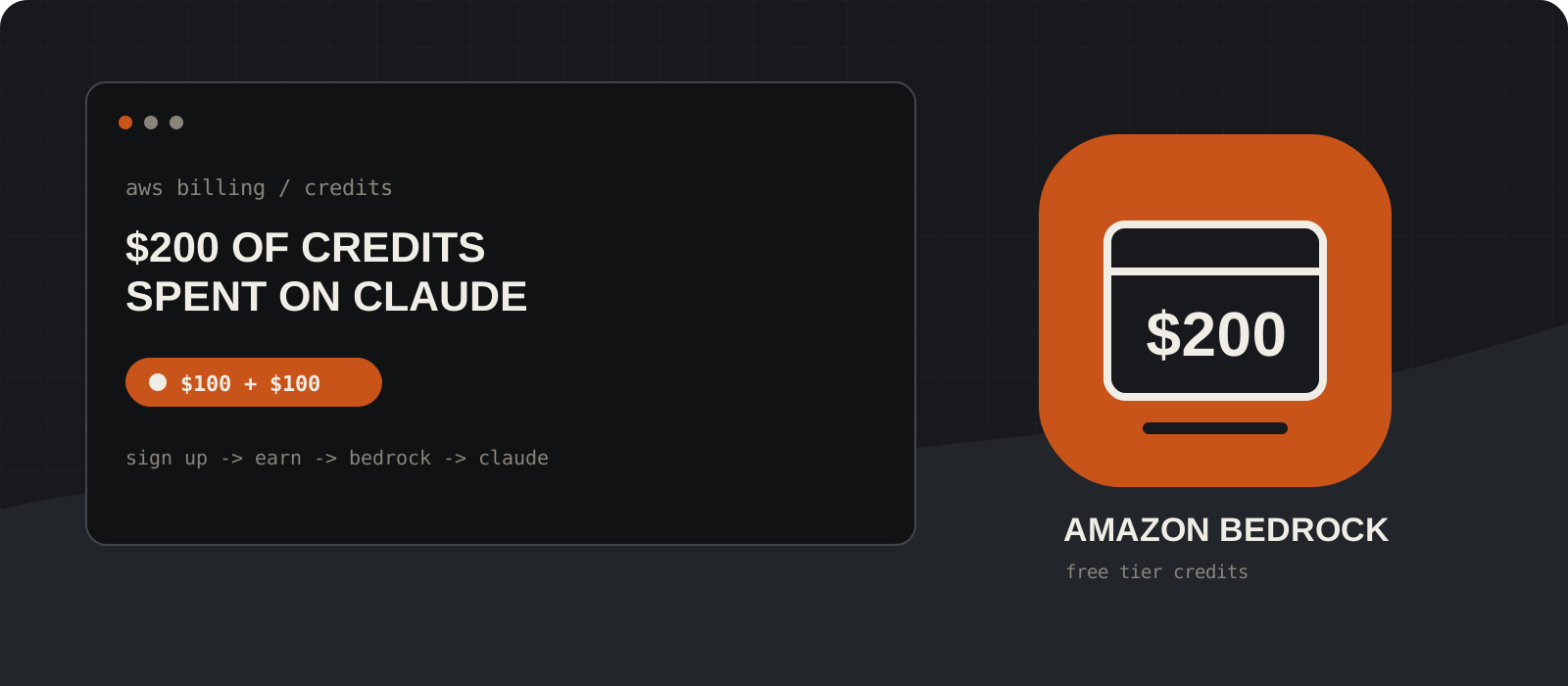
New AWS accounts get $100 in credits at sign-up and can earn up to $100 more by finishing five short activities, and one of those activities uses Amazon Bedrock, where Claude lives. That is where the popular story ends with $200 of free Claude. Here is the part it leaves out. Claude on Bedrock is billed through AWS Marketplace, AWS's promotional credit terms list Marketplace as ineligible, and we could not find a single AWS page saying Free Tier credits pay for Claude. So this guide follows the whole path a new builder takes: open the account, collect both $100 halves, set a budget before spending anything, get Claude access, call it from the terminal and from Python, and then open Billing to see for yourself whether the credits covered the charge. Everything below was checked against AWS and Anthropic documentation on 15 September 2026.
System requirements
Account
A brand-new AWS account
Free Tier credits are for new customers only. You are not eligible if you have, or have ever had, an AWS account, and credits are limited to one account. Accounts opened before 15 July 2025 stay on the older Free Tier.
Sign-up details
Email, phone number, and a payment method
AWS verifies these during sign-up. Claude needs a valid payment method on the account in any case, because it is purchased through AWS Marketplace.
Region
A commercial AWS Region, such as us-east-1
The credit offer does not apply in the AWS GovCloud (US) or China Regions. Pick one Region where your Claude model runs and use it for every step.
Software
A browser, AWS CLI v2.32.0 or newer, Python 3 optional
The five activities run in the console. The terminal steps need AWS CLI version 2.32.0 or later for aws login. The Python step also needs boto3.
Internet
Required
Bedrock is a hosted service. Prompts leave your machine and are processed in AWS, so nothing here works offline.
Cost
$100 plus up to $100 in credits; Claude may be billed to your card
The credits expire 12 months after the account opens. Claude is billed through AWS Marketplace, and AWS does not document Free Tier credits applying to it. Budget for Claude as paid usage.
Open a new AWS account and choose a plan
The plan you pick during sign-up decides whether Claude is realistic on this account.
Start from the AWS Free Tier page and create an account. During sign-up AWS asks you to choose the Free plan or the Paid plan. Both start with the same $100 credit and both can earn the extra $100.
The Free plan never charges you. In exchange it limits you to select services, excludes certain AWS Marketplace offers that can incur charges, and closes the account after six months or when the credits run out, whichever comes first. The Paid plan opens every service and keeps the account alive, and it bills you for anything the credits do not cover.
If Claude is the reason you are here, read the Free plan versus Paid plan comparison further down before you choose. You can start on the Free plan and upgrade later, and any remaining credits carry over to the Paid plan.
Tip
Keep this account out of AWS Organizations while you test. Joining an organization upgrades a Free plan account to the Paid plan, and the AWS Free Tier FAQ warns that it can end your Free Tier credits.
Confirm your first $100 and find the activity checklist
Check that the credit landed before you touch any service.
Open the Billing and Cost Management console and choose Credits. The $100 sign-up credit should be listed there with its expiry date. Free Tier credits last 12 months from the day the account opened, even though the Free plan itself lasts six.
Go back to Console Home and find the Explore AWS widget. It lists five activities worth $20 each: launch an instance with Amazon EC2, use a foundation model in the Amazon Bedrock playground, set up a cost budget with AWS Budgets, create a web app with AWS Lambda, and create an Amazon RDS database. You have six months from account creation to finish them.
Tip
AWS emails you when 50%, 25%, and 10% of your credits remain, and again 15, 7, and 2 days before the Free plan ends. Sign up with an inbox you read.
Set a budget before you spend anything
The budget activity pays $20 and uses no credits, so do it first.
In Billing and Cost Management, open Budgets, choose Create budget, then Use a template (simplified). A Zero spend budget emails you as soon as spending goes beyond Free Tier limits. A Monthly cost budget emails you when actual or forecast spend crosses an amount you set. For a first Claude experiment, $5 is a sensible line; that number is our suggestion, not an AWS default.
Budget monitoring and notifications are free. Cost data can take up to 24 hours to show up, which means a budget warns you after the fact. It will not stop a script that keeps calling a model.
Earn $20 in the Bedrock playground
One prompt to any model completes the activity.
Launch the Bedrock activity from the Explore AWS widget so AWS tracks it. The activity asks you to choose a model and submit a prompt in the Amazon Bedrock playground. It does not require a particular model.
AWS notes that this activity incurs service charges deducted from your credits. One short prompt to a small model costs very little, and completing the activity adds $20.
On a Free plan account, pick one of Amazon's own models, such as Amazon Nova, for this activity. Claude may not be available to the account until the Marketplace requirements in step 06 are met, and you do not want the $20 to hinge on that.
Finish the other three activities, then clean up
EC2, Lambda, and RDS each pay $20, and each keeps spending if you leave it running.
Follow each guided activity from the widget and choose the smallest instance and database sizes it offers. The goal is the credit, not a workload.
When each credit appears, delete what you built. Terminate the EC2 instance, delete the Lambda function, and delete the RDS database, skipping the final snapshot if you have no data to keep. A forgotten database quietly eats the balance you meant to spend on models.
After all five, the Credits page should show close to $200 in total. It will be slightly less, because four of the activities consume credits while you complete them.
Get the account ready for Claude
Claude is a third-party model, so it has its own access checks on top of Bedrock.
Bedrock no longer has a Model access page to click through. Access to foundation models is on by default, and the first call to a third-party model starts an AWS Marketplace subscription in the background. That can take up to 15 minutes. The first call needs a valid payment method on the account and IAM permission for aws-marketplace:Subscribe, aws-marketplace:Unsubscribe, and aws-marketplace:ViewSubscriptions.
Anthropic models also need a one-time First Time Use form. Open Amazon Bedrock in the console, find a Claude model in the model catalog, and submit the short use-case form. If you are building on your own, a portfolio, GitHub profile, or project URL is enough. AWS says access is granted as soon as the form is submitted.
Do not count on Claude working on the Free plan. The Free plan excludes certain Marketplace offers that can incur charges, and AWS re:Post threads describe new and Free Tier accounts getting AccessDeniedException on Anthropic models. If that happens to you after the form and the 15-minute wait, upgrade to the Paid plan or open an AWS Support case.
Install the AWS CLI and sign in
AWS CLI 2.32.0 or newer adds aws login, the recommended way to get short-lived credentials.
Install AWS CLI version 2 with the official installer for your platform. Open a new terminal afterwards so the aws command is on your PATH, then check the version.
Run aws login. It opens your browser, reuses your console sign-in, and refreshes credentials for up to 12 hours. Sign in as an IAM user rather than the root user. That IAM user needs the SignInLocalDevelopmentAccess managed policy for aws login, plus Bedrock permissions; AmazonBedrockFullAccess is fine while you learn.
On a machine without a browser, use aws login --remote. Skip long-term access keys through aws configure, which AWS marks as not recommended.
msiexec.exe /i https://awscli.amazonaws.com/AWSCLIV2.msicurl "https://awscli.amazonaws.com/AWSCLIV2.pkg" -o "AWSCLIV2.pkg"
sudo installer -pkg AWSCLIV2.pkg -target /curl "https://awscli.amazonaws.com/awscli-exe-linux-x86_64.zip" -o "awscliv2.zip"
unzip awscliv2.zip
sudo ./aws/installaws --version
aws loginTip
On Linux ARM machines, use the awscli-exe-linux-aarch64.zip file in the same three commands.
Call Claude from your terminal
Put the message in a file so the JSON survives every shell's quoting rules.
The Converse API uses the same request shape for every Bedrock model. The commands below write a one-message conversation to messages.json and send it to Claude Sonnet 5 through its global inference profile, which costs about 10% less than a regional profile such as us.anthropic.claude-sonnet-5.
Sonnet 5 uses adaptive thinking by default, so the response can include a reasoning block before the answer. The --query filter prints only the text blocks.
If you get AccessDeniedException, go back to step 06: the plan, the First Time Use form, or IAM permissions is missing. A ValidationException about on-demand throughput means you passed the bare model ID; use the global. or us. profile ID instead.
Set-Content -Path messages.json -Encoding ascii -Value '[{"role":"user","content":[{"text":"Explain AI agents in two sentences."}]}]'
aws bedrock-runtime converse `
  --region us-east-1 `
  --model-id global.anthropic.claude-sonnet-5 `
  --messages file://messages.json `
  --inference-config maxTokens=1024 `
  --query "output.message.content[?text].text" `
--output textcat > messages.json <<'EOF'
[{"role":"user","content":[{"text":"Explain AI agents in two sentences."}]}]
EOF
aws bedrock-runtime converse \
--region us-east-1 \
--model-id global.anthropic.claude-sonnet-5 \
--messages file://messages.json \
--inference-config maxTokens=1024 \
--query 'output.message.content[?text].text' \
--output textCall Claude from Python
The same request through boto3, printing the answer and the token count you are paying for.
Create a virtual environment and install boto3. The script reads the credentials from your AWS profile, so no keys go in the file.
If boto3 cannot find credentials from aws login, generate a short-term Bedrock API key in the Bedrock console and set it as the AWS_BEARER_TOKEN_BEDROCK environment variable. AWS documents that variable working with boto3 Converse calls, and short-term keys expire within 12 hours.
import boto3

client = boto3.client("bedrock-runtime", region_name="us-east-1")

response = client.converse(
    modelId="global.anthropic.claude-sonnet-5",
    messages=[{"role": "user", "content": [{"text": "Explain AI agents in two sentences."}]}],
    inferenceConfig={"maxTokens": 1024},
)

for block in response["output"]["message"]["content"]:
    if "text" in block:
        print(block["text"])

usage = response["usage"]
print(f"input tokens: {usage['inputTokens']}, output tokens: {usage['outputTokens']}")py -m venv .venv
.venv\Scripts\Activate.ps1
pip install --upgrade boto3
python claude_bedrock.pypython3 -m venv .venv
source .venv/bin/activate
pip install --upgrade boto3
python claude_bedrock.pyCheck whether the credits paid for Claude
Your own bill answers the $200 question. Screenshots and blog posts, this one included, do not.
Wait a day after your first requests. Claude charges do not appear under Amazon Bedrock; AWS lists them under the model provider on your bill and in Cost Explorer. Open Cost Explorer, group costs by service, and look for the Claude line.
Now open Bills and Credits in Billing and Cost Management. The Bills page shows which charges had credits applied against them. If the Claude charge was offset and your credit balance fell by the same amount, the credits covered it. If the charge stands at full price while the balance stays put, your payment method is paying for Claude.
Only after this check should you build anything that loops, retries, or runs on a schedule.
Tip
Promotional credits never cover sales or similar transaction taxes, so expect a small tax line even when credits cover everything else.
The $200 Claude story, told straight
It usually starts with a screenshot. Someone opens a new AWS account, sees $100 in credits, finds a checklist that pays $20 per task, and notices that one task is Amazon Bedrock. Bedrock hosts Claude. The conclusion writes itself: $200 of Claude, free.
Most links in that chain hold. The credits are real. The Bedrock activity is real. Claude Sonnet 5 and Opus 5 both run on Bedrock. The weak link is the final hop from Bedrock to Claude, because Claude's model cards say it is offered and billed through AWS Marketplace and shows up under the model provider, not under Amazon Bedrock. AWS Marketplace sits on the ineligible list in AWS's promotional credit terms.
AWS has carved out an exception before. Its Activate credits for startups explicitly count Bedrock third-party model spend as eligible. We found no matching sentence in the Free Tier terms. The honest story is shorter: $200 to learn AWS and Bedrock, with a real chance that Claude lands on your card. Step 10 shows how to find out on your own account.
Do AWS Free Tier credits cover Claude on Bedrock?
AWS does not confirm it, and the documented rules lean toward no. Claude on Bedrock is a Marketplace charge, AWS's credit terms exclude AWS Marketplace, and the Free Tier terms add no exception for third-party Bedrock models. Treat Claude as paid usage until your own Credits page shows otherwise.
Free plan or Paid plan if you want Claude?
| Free plan | Paid plan |
|---|---|
| No charges at all | You pay for anything credits do not cover |
| Select services; certain Marketplace offers excluded | All services, including Marketplace-billed models like Claude |
| Closes after six months or when credits run out | Account stays open |
| Not eligible for other promotional credits | Remaining Free Tier credits still apply |
| Good for the five activities and learning Bedrock | The practical choice if Claude is the goal |
What does $200 buy in Claude tokens?
If the credits did cover Claude, or you decide to spend $200 of your own, this is the scale at global inference profile prices. Regional profiles such as us. cost about 10% more. Each example request uses 2,000 input tokens and 500 output tokens.
- Claude Haiku 4.5 at $1 input and $5 output per million tokens: about $0.0045 per request, or roughly 44,000 requests. Its Bedrock model card lists end of life no sooner than October 2026, so do not start a new project on it.
- Claude Sonnet 5 at $2 input and $10 output: about $0.009 per request, or roughly 22,000 requests.
- Claude Opus 5 at $5 input and $25 output: about $0.0225 per request, or roughly 8,900 requests.
- Real requests usually cost more than this arithmetic. Claude models from 4.7 onward use a tokenizer that produces about 30% more tokens for the same text, and adaptive thinking on Sonnet 5 and Opus 5 adds output tokens.
Points to consider before you start
- Four of the five activities spend credits while earning them, so your net total lands a little under $200.
- Promotional credits do not cover AWS Marketplace, sales taxes, Enterprise-level support plans, Savings Plans, or Reserved Instance upfront fees.
- When the Free plan ends, the account closes automatically. AWS keeps your content for 90 days, then deletes it unless you upgrade.
- Budgets send alerts; they do not block spending. A loop calling Opus 5 can cost real money before the next alert arrives.
- Bedrock is hosted. Your prompts go to AWS, so do not send secrets or customer data you are not allowed to share.
- Model IDs, prices, and Free Tier rules change. Recheck the model card and your Credits page before any larger run.
- Opening a second account for another $200 breaks the Free Tier terms, which limit credits to one account.
Our verdict
I would take the $200. The budget and Bedrock activities teach the two habits that matter most on AWS, cost alerts and model calls, and they pay $40 for the lesson. The EC2, Lambda, and RDS activities are worth doing too, as long as you delete what you build.
I would not open an AWS account because a post promised $200 of free Claude. Go in expecting Claude to be paid usage at $2 and $10 per million tokens for Sonnet 5, send one small request, and check the bill the next day. If the credits covered it, enjoy the bonus. If they did not, you still have a working Claude setup with cost alerts, and $200 of credits for the rest of your agent's AWS stack.
Claim the $200 to learn AWS, and treat Claude as paid usage until your own bill proves otherwise.
Frequently asked questions
Does AWS really give new accounts $200 in free credits?+
Yes, to new customers. You get $100 at sign-up and $20 for each of five activities, up to $100 more, completed within six months of opening the account. The credits expire 12 months after the account opens.
Can I use AWS Free Tier credits to pay for Claude?+
AWS does not say you can. Claude on Bedrock is billed through AWS Marketplace, and AWS's promotional credit terms list Marketplace as ineligible. Send one small request and check the Bills and Credits pages to see how your account treated it.
Can a Free plan account use Claude on Amazon Bedrock?+
Bedrock itself is available on both plans. Claude also needs a valid payment method for Marketplace purchases and the Anthropic First Time Use form, and the Free plan excludes certain Marketplace offers. Community reports describe Free Tier accounts hitting AccessDeniedException on Anthropic models, so plan on the Paid plan if Claude is your goal.
Does the Bedrock playground activity have to use Claude?+
No. The activity asks you to choose a model and submit a prompt. Any model completes it, so pick a small Amazon model and keep the prompt short.
What happens when the Free plan ends?+
The account closes automatically after six months or when the credits run out. AWS keeps your content for 90 days, and you can upgrade to the Paid plan during that window to keep your resources and any remaining credits. After that, the account and its content are deleted.
Which Claude model should a beginner start with on Bedrock?+
Claude Sonnet 5, at $2 input and $10 output per million tokens on the global profile. Move to Opus 5 for harder reasoning work. Avoid starting new projects on Haiku 4.5, because its Bedrock model card lists end of life as early as October 2026.
Can I open another AWS account to get another $200?+
No. The Free Tier terms limit credits to one account, and you are not eligible if you have or have had an AWS account before.