The Patch Window Is Gone: What Google's Automated Exploit Agent Means for Agent Builders
Google's Threat Intelligence Group found exploit_agent, a multi-agent LLM framework set up to diff security patches, draft exploits and run them with no human in the loop. What Google confirmed, what it did not, and the patching and agent-permission changes to make this week.
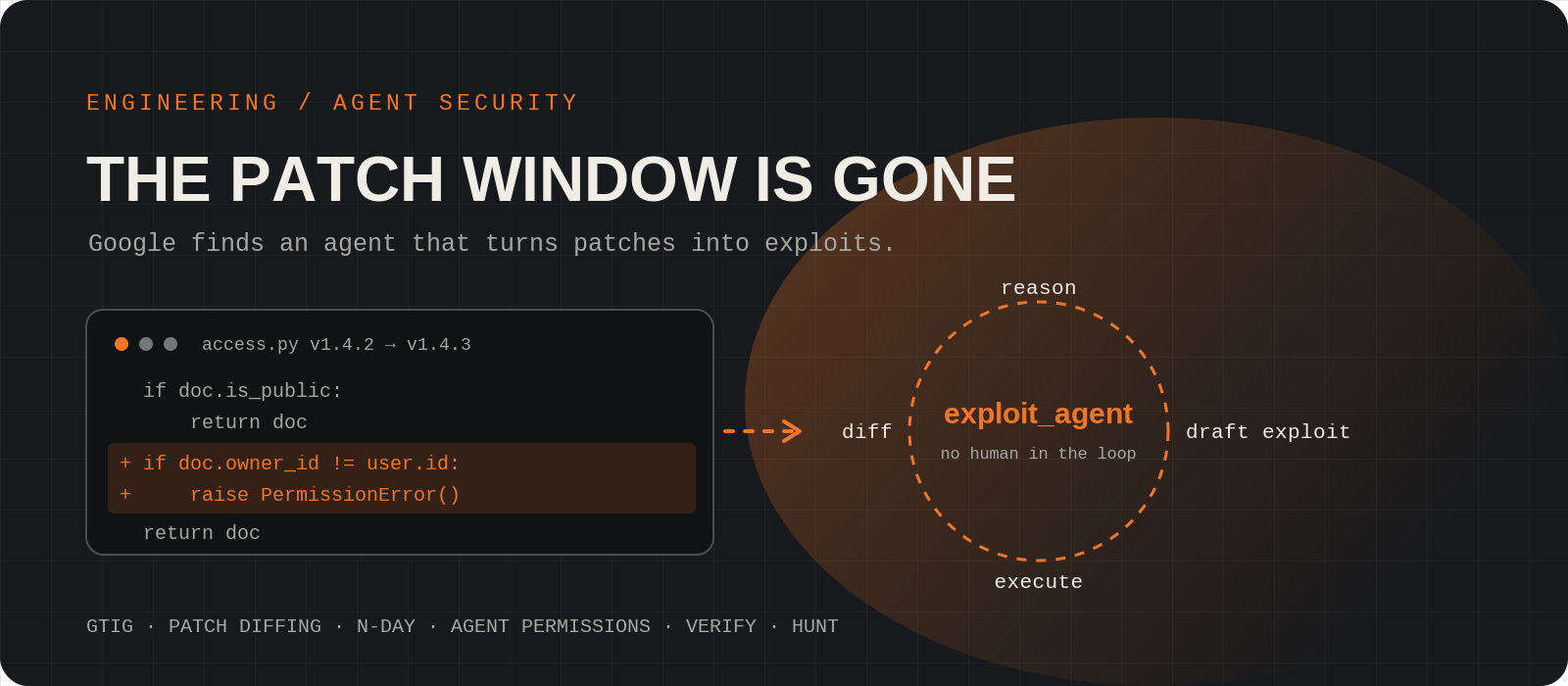
Is the patch window gone? Not literally, but you can no longer assume you have days. Google's Threat Intelligence Group (GTIG) reports that it found an exposed staging server hosting exploit_agent, a multi-agent framework wired to several frontier and local LLMs. According to GTIG, it was set up to compare popular web application software before and after patch announcements, work out the likely vulnerability, draft an exploit and run it "without human intervention". GTIG says this is the first time it has seen threat actors use LLM frameworks to fully automate vulnerability discovery and exploitation without a human in the loop. Google does not say how often the framework succeeded, and it does not tie it to a named group. What the report does show, together with a PaperCut campaign that went from advisory to hundreds of victims in about four days, is that the slow manual work between a patch and a working exploit is being automated. This guide covers what Google found, how patch diffing works, the patching changes that follow, and what agent builders should copy, and refuse to copy, from an offensive agent pipeline.
System requirements
Who this is for
Developers, security engineers and anyone building agents that can run code
Steps 01 to 06 explain the finding and the patch-to-exploit problem. Steps 07 to 09 are patching changes for teams that run internet-facing software. Steps 10 and 11 are for agent builders.
What you need for the commands
A terminal, curl and jq, Docker, and optionally Trivy
Commands are labelled for macOS and Linux (bash) or Windows (PowerShell). WSL or Git Bash also run the bash versions on Windows. Nothing here needs paid tools.
Primary source
GTIG AI Threat Tracker: "Agentic Threat Activity Crosses a Significant Threshold"
Dated 17 November 2026 on Google's blog. Every exploit_agent claim below was read against that page on 17 November 2026. PaperCut, PHP and CISA details were checked against GreyNoise, Huntress and CISA on the same day.
Read it as
A threat report about capability, not a breach count
Google confirms what the framework was built to do. It does not publish a success rate, a victim count or a measured patch-to-exploit time for exploit_agent.
What Google found on the staging server
A pipeline from patch to running exploit, plus victim data and post-compromise tooling.
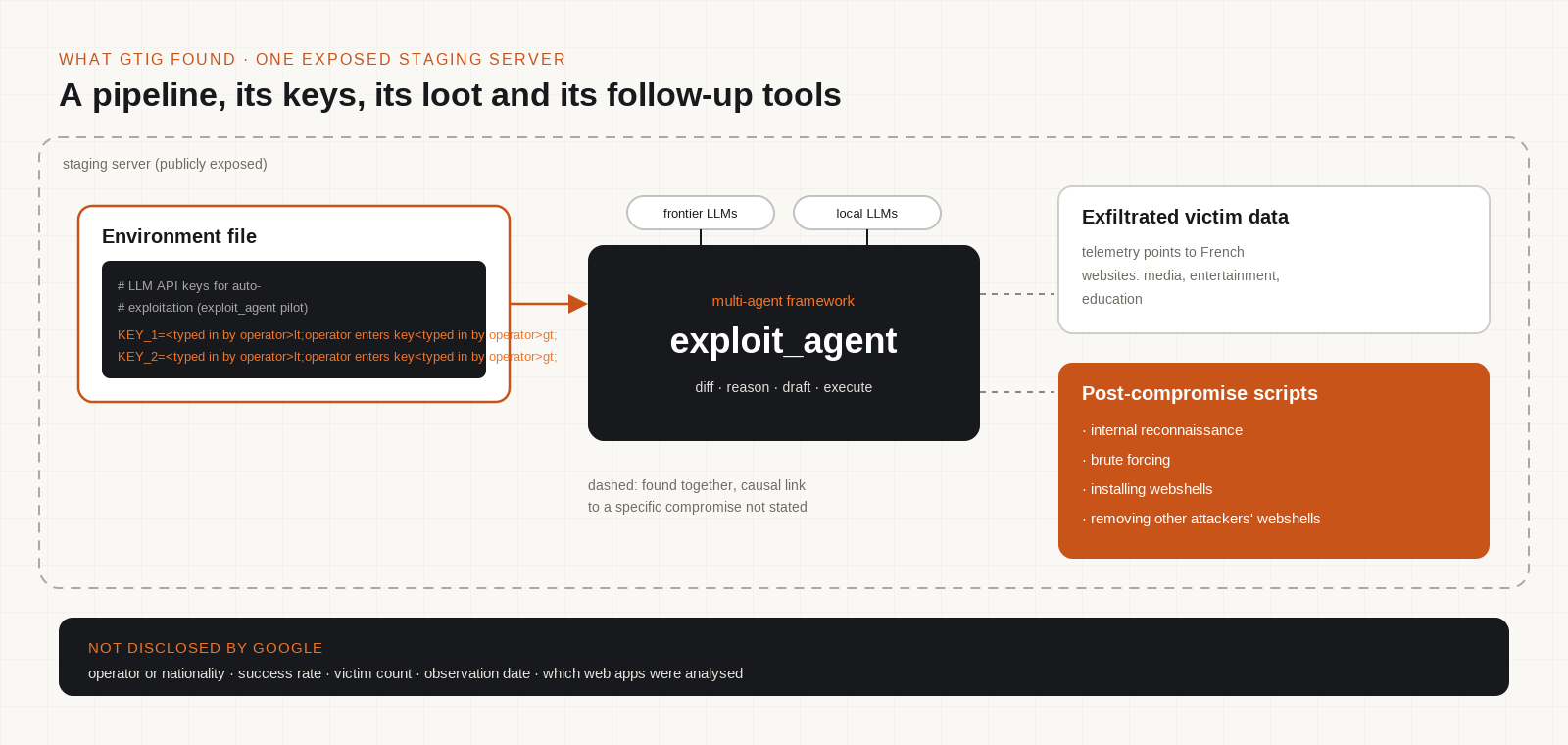
GTIG's wording is precise, so here it is. "GTIG identified an exposed staging server hosting a multi-agent vulnerability research and weaponization framework, dubbed exploit_agent, that integrates with multiple frontier and local LLMs." It is "set up to conduct continuous differential analysis of popular web application software. It compares code before and after patch announcements, analyzes findings to identify potential vulnerabilities, drafts exploits, and automatically executes them without human intervention."
The server held more than the framework. GTIG found data exfiltrated from targeted victims and scripts for post-compromise work: internal reconnaissance, brute forcing, installing webshells and removing other attackers' webshells. Victim telemetry suggested the operator was interested in French websites in media and entertainment, and in the education sector.
The report shows one figure of the framework at work: it inspects the access-control code of a WordPress plugin, Spectra (Ultimate Addons for Gutenberg) version 2.19.25. GTIG does not say that plugin was exploited or that the finding led to a CVE. Treat it as an illustration of the kind of code the framework reads.
An environment file configured the LLM API keys. Its comments, which GTIG translates from Russian, include "LLM API keys for auto-exploitation (exploit_agent pilot)" and an instruction for the operator to enter the keys into the file themselves rather than in a chat. Two things follow. A person set the system up, so "no human in the loop" describes the exploit pipeline, not the whole operation. And Russian-language comments are not attribution; Google names no actor for exploit_agent.
What Google's report does not say
Keep these limits in every retelling. Most headlines have not.
GTIG confirms the framework's design and that the same server held victim data and post-compromise scripts. It does not say that any particular exploit drafted by exploit_agent compromised any particular victim. Those are different claims, and the evidence supports only the first.
It also gives no success rate, no victim count, no date for the observation beyond "the past quarter", and no list of the web applications analysed. It does not attribute exploit_agent to a group or a country.
The "first time" claim covers the category. GTIG writes that "in the past quarter, GTIG identified threat actors using LLM frameworks to fully automate vulnerability discovery and exploitation without a human in the loop for the first time". exploit_agent is its main example, but the sentence is about what GTIG has observed overall.
GTIG is also blunt that much AI-generated attack code does not work: "the lower barrier to entry has fueled a wave of LLM-generated exploits that are claimed to work but don't." Automation multiplies attempts. It does not make every attempt succeed.
Tip
If you share this story internally, lead with "designed to" and "configured to". "Google caught an AI hacking websites on its own" overstates the evidence and will be corrected by someone in the thread.
How patch diffing works, with a small example
A security fix shows defenders and attackers where the bug was.
Patch diffing means comparing the vulnerable and patched versions of the same code to see what changed. Security fixes tend to be small and specific: a new permission check, a bounds check, an escaped value. That makes them easy to spot in a diff, and each one points at the mistake it fixes.
Here is an illustrative example, written by us. It is not code from Google's report or from exploit_agent. Before the patch, any user who asks for a private document gets it. After the patch there is an ownership check.
Anyone reading the diff can infer the bug: an access-control flaw where private documents were readable by other users. From there the questions are mechanical. Which endpoint calls this function? Does it need a login? Which document IDs exist? Those questions are exactly what an LLM with code-search tools is good at answering quickly, which is why this step is the one being automated.
Defenders can use the same technique. When a dependency you run ships a security release, read its diff. Ten minutes with the change tells you more about your exposure than the advisory's one-line summary.
# v1.4.2 (vulnerable): any logged-in user can read any document
def access_document(user, document):
    if document.is_public:
        return document
    return document          # missing ownership check

# v1.4.3 (patched)
def access_document(user, document):
    if document.is_public:
        return document
    if document.owner_id == user.id:
        return document
raise PermissionError("Access denied")git clone https://github.com/OWNER/PROJECT.git && cd PROJECT
git log --oneline v1.4.2..v1.4.3
git diff v1.4.2 v1.4.3 --stat
git diff v1.4.2 v1.4.3 -- src/From diff to running exploit: why the agent loop matters
Each step existed before. Connecting them without a person in between is what changed.
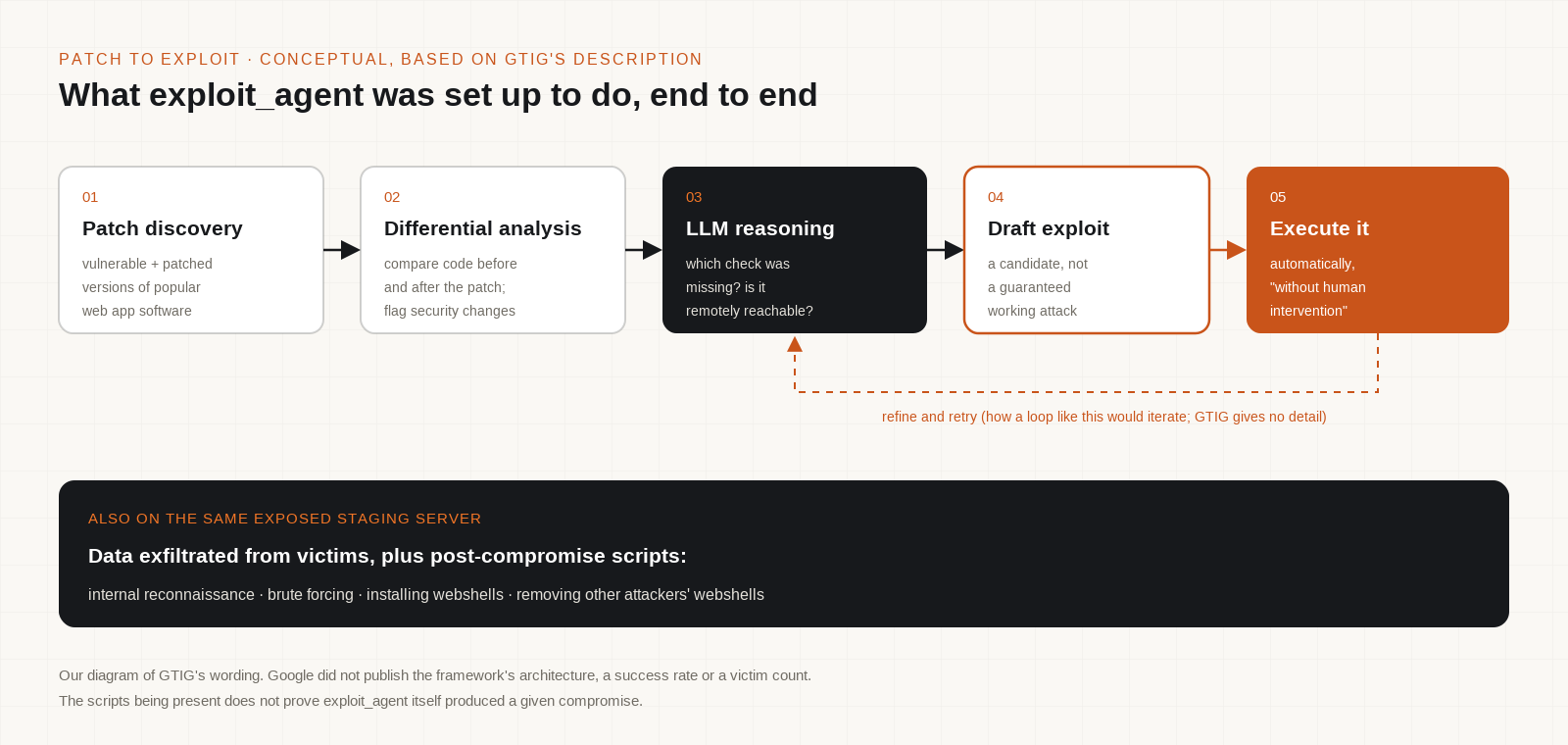
None of the individual capabilities is new. Researchers already use LLMs to read code, explain advisories, suggest suspicious functions and write proof-of-concept code. What GTIG describes is those steps chained into a continuous pipeline: collect patched releases, diff them, reason about the change, draft an exploit candidate, run it, and keep going.
Execution is the important link. A drafted exploit is a guess. It may be wrong about the vulnerable path, need a login it does not have, or work only on one configuration. A system that can run its own candidates, read the result and try again turns many cheap guesses into a few working attacks, and it does this around the clock across many projects at once.
The diagram below is our reading of GTIG's description, not an architecture Google published.
The patch window in real dates: the PaperCut campaign
Advisory on 27 August. First victim on 31 August. Hundreds of organisations from 1 September.
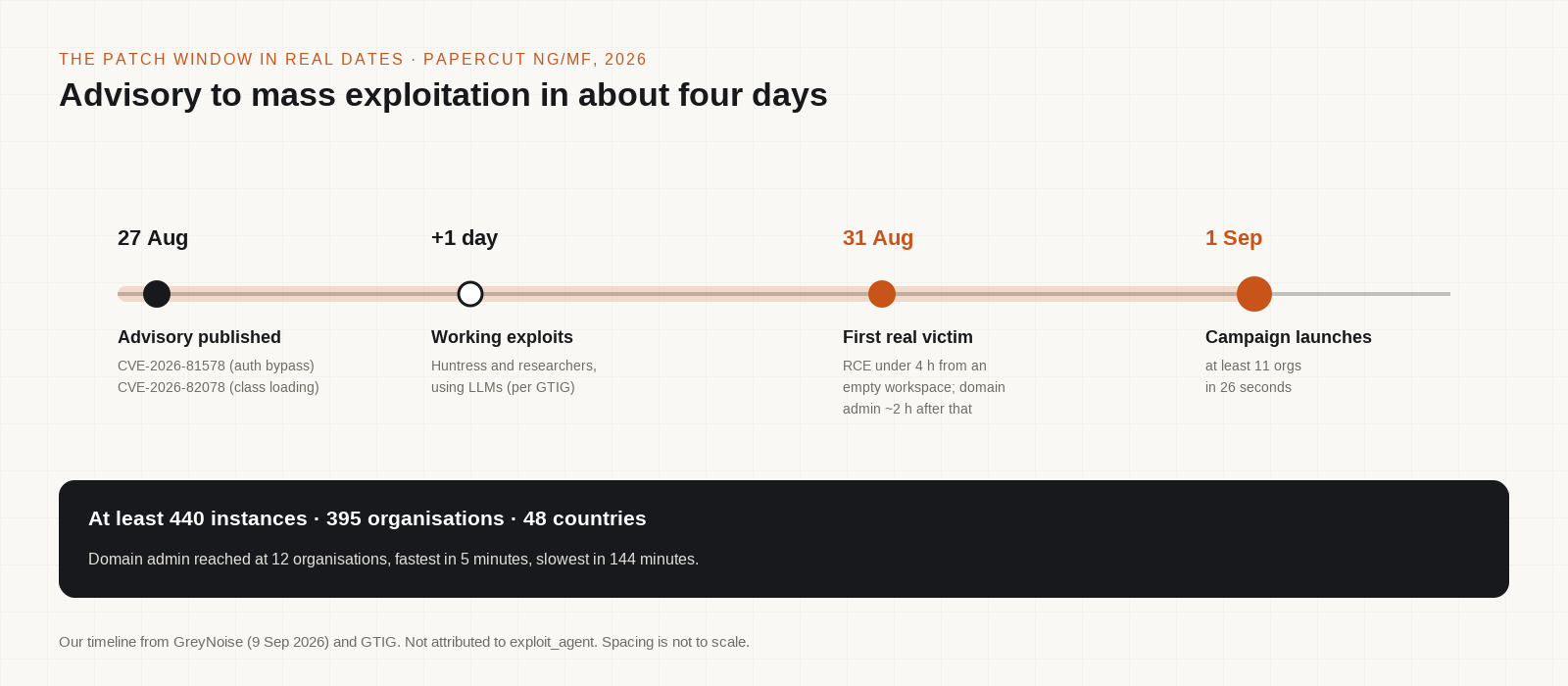
For a measured timeline, look at a different case in the same GTIG report. Two PaperCut NG/MF vulnerabilities, CVE-2026-81578 (an authentication bypass) and CVE-2026-82078 (unsafe dynamic class loading), chain into unauthenticated remote code execution on print management servers. GTIG says they were exploited as zero-days in late August 2026, and that security researchers and Huntress used LLMs to build working exploits within a day of disclosure.
GreyNoise then documented what it calls an AI-orchestrated campaign by a likely Russian-speaking actor. PaperCut's advisory went out on 27 August. GreyNoise says the attacker went from an empty workspace to remote code execution against a real victim in just under four hours, on 31 August, and reached domain admin about two hours later. The full campaign launched on 1 September and compromised at least 11 organisations in 26 seconds.
GreyNoise counted at least 440 PaperCut instances at 395 organisations in 48 countries. Domain admin was reached at 12 of them, the fastest in five minutes and the slowest in 144 minutes.
This campaign is not attributed to exploit_agent, and you should not present it that way. It is evidence for the wider point: when a working exploit can exist within a day and a campaign within four, a monthly patch cycle leaves internet-facing systems exposed for weeks.
PHP2Shell: leaked fixes and a flood of fake proofs of concept
Two critical PHP flaws show both sides: faster discovery, and more noise.
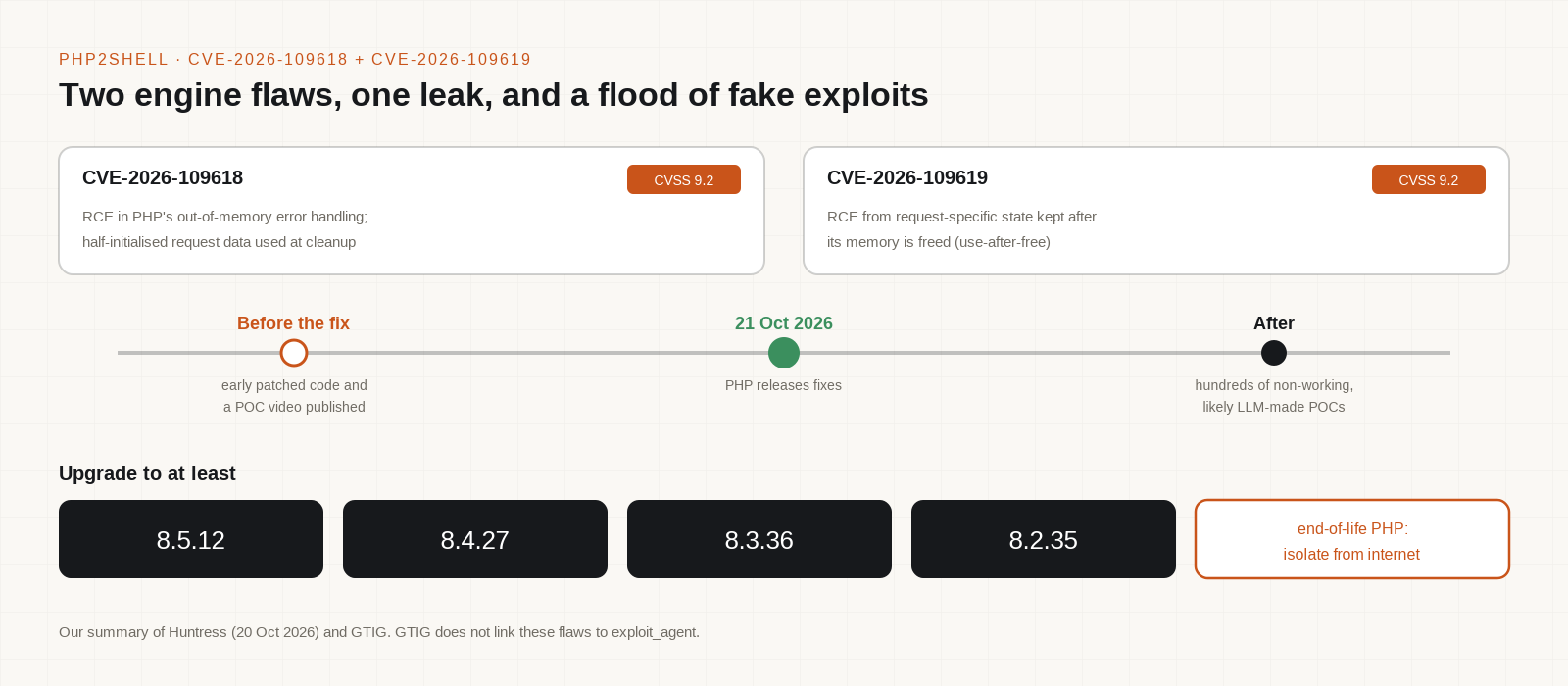
GTIG's second example is a pair of PHP engine flaws, CVE-2026-109618 and CVE-2026-109619. GTIG says they were discovered using LLM-enabled analysis, and that a proof-of-concept video and early patched code were published before the official fix. Huntress rates both CVSS v4.0 9.2. CVE-2026-109618 is a remote code execution flaw in PHP's out-of-memory error handling; CVE-2026-109619 comes from PHP keeping request-specific state after its memory has been freed.
PHP shipped fixes on 21 October 2026: 8.5.12, 8.4.27, 8.3.36 and 8.2.35. Because the bug is in the engine, applications built on PHP are exposed even when their own code is clean. Huntress's advice starts with inventory: find every PHP install you own, "including the ones hiding inside vendor software", and isolate end-of-life PHP from the internet.
GTIG adds a detail defenders should remember: after the leak, "hundreds of claimed but non-functional POCs, likely generated with the help of LLMs, were published." Do not run random proof-of-concept code from GitHub against your servers to check exposure. Check versions, apply the fix, and hunt for signs of compromise.
GTIG does not say these PHP flaws were exploited by exploit_agent. They are a separate case of the same pattern.
Fix 1: know every version you run, including the hidden ones
You cannot patch in hours what you cannot list in minutes.
Speed starts with inventory. For each internet-facing service you need its software, its version, where it runs and who owns it. That includes container images, vendor appliances that bundle their own runtimes, plugins, and the forgotten staging box. A fresh advisory should turn into an answer like "we run 8.3.30 on three hosts and two images" within minutes, not after a week of tickets.
Automate the boring part. Generate an SBOM for each image, scan images and repositories on every build, and let a dependency bot open pull requests for security releases. OWASP Dependency-Check, Trivy, Snyk and Dependabot all do some of this; pick one that fits your stack and run it in CI rather than by hand.
which -a php php8.3 php8.2 2>/dev/null
for p in $(which -a php 2>/dev/null); do "$p" -r 'echo PHP_BINARY, " ", PHP_VERSION, PHP_EOL;'; doneGet-ChildItem C:\ -Recurse -Filter php.exe -ErrorAction SilentlyContinue |
ForEach-Object { "$($_.FullName) $(& $_.FullName -r 'echo PHP_VERSION;')" }trivy image --severity CRITICAL,HIGH your-registry/your-app:latest
trivy fs --scanners vuln --severity CRITICAL,HIGH .Tip
Huntress's point about PHP applies to every runtime: the copy you forgot is the one inside a vendor product. Search for binaries, not just packages.
Fix 2: prioritise by exposure and automation, not CVSS alone
CISA's new directive is a good model even if it does not bind you.
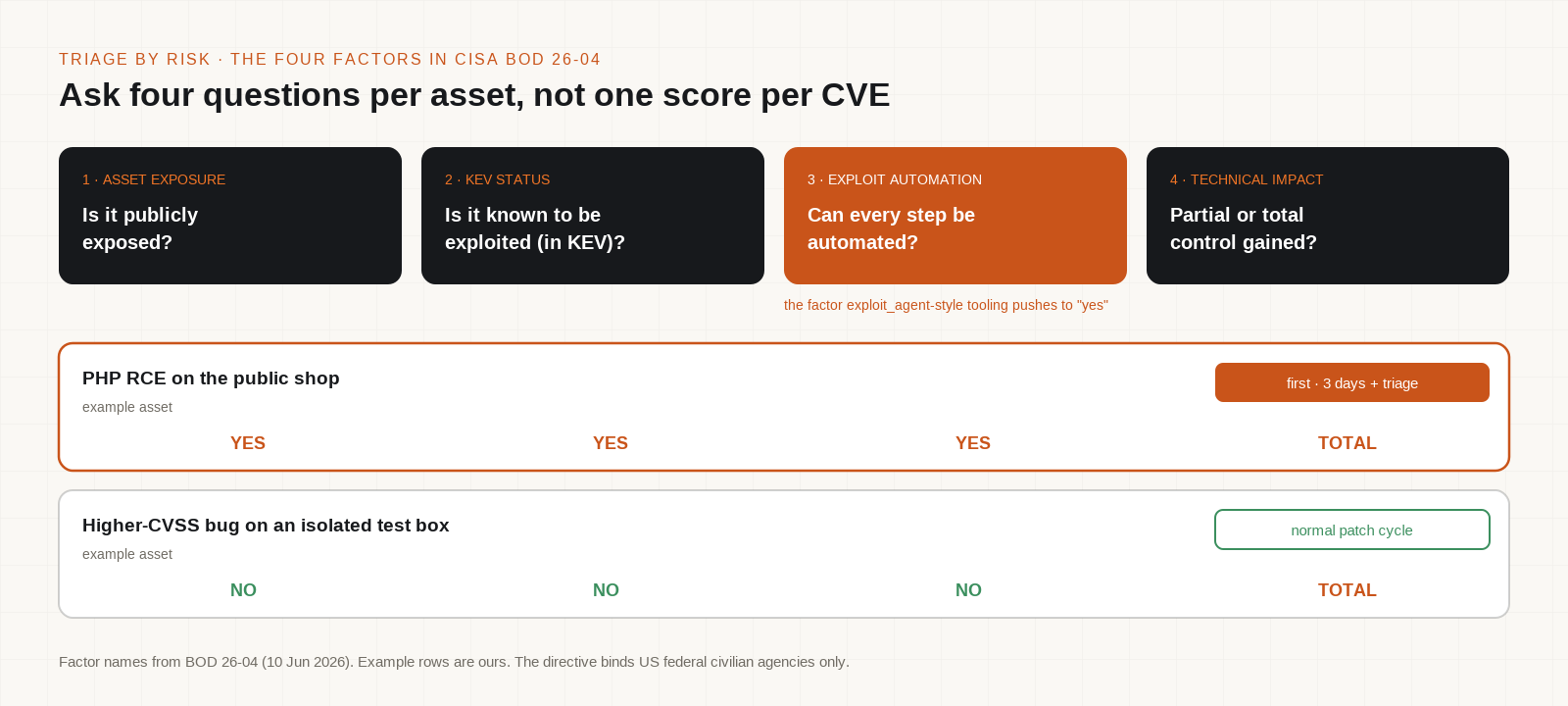
A CVSS score describes the bug. It does not tell you whether your copy is on the internet, whether attackers are using it, or how bad a compromise would be for you. CISA's Binding Operational Directive 26-04, issued on 10 June 2026, replaces older KEV-driven deadlines with four questions per asset: is it publicly exposed, is the CVE in the Known Exploited Vulnerabilities (KEV) catalog, can an adversary automate every step of exploitation, and does exploitation give partial or total control?
The third question is the one this article is about. Exploit automation is now an explicit factor in federal patch deadlines. For the highest-risk combinations, the remediation timeline is three days, and in designated scenarios agencies must also run a forensic triage to check whether the asset was compromised before the fix went in.
BOD 26-04 binds US federal civilian agencies only. The four questions still work as a triage rule for anyone: an exposed, automatable, actively exploited remote code execution bug jumps the queue, even if a higher-CVSS bug on an internal test box waits.
curl -s https://www.cisa.gov/sites/default/files/feeds/known_exploited_vulnerabilities.json |
  jq -r '.vulnerabilities | sort_by(.dateAdded) | reverse | .[:10][] |
"\(.dateAdded) \(.cveID) \(.vendorProject) \(.product)"'(Invoke-RestMethod https://www.cisa.gov/sites/default/files/feeds/known_exploited_vulnerabilities.json).vulnerabilities |
Sort-Object dateAdded -Descending | Select-Object -First 10 dateAdded, cveID, vendorProject, productFix 3: shrink exposure while you patch, then verify and hunt
A patch closes the hole. It does not remove someone already inside.
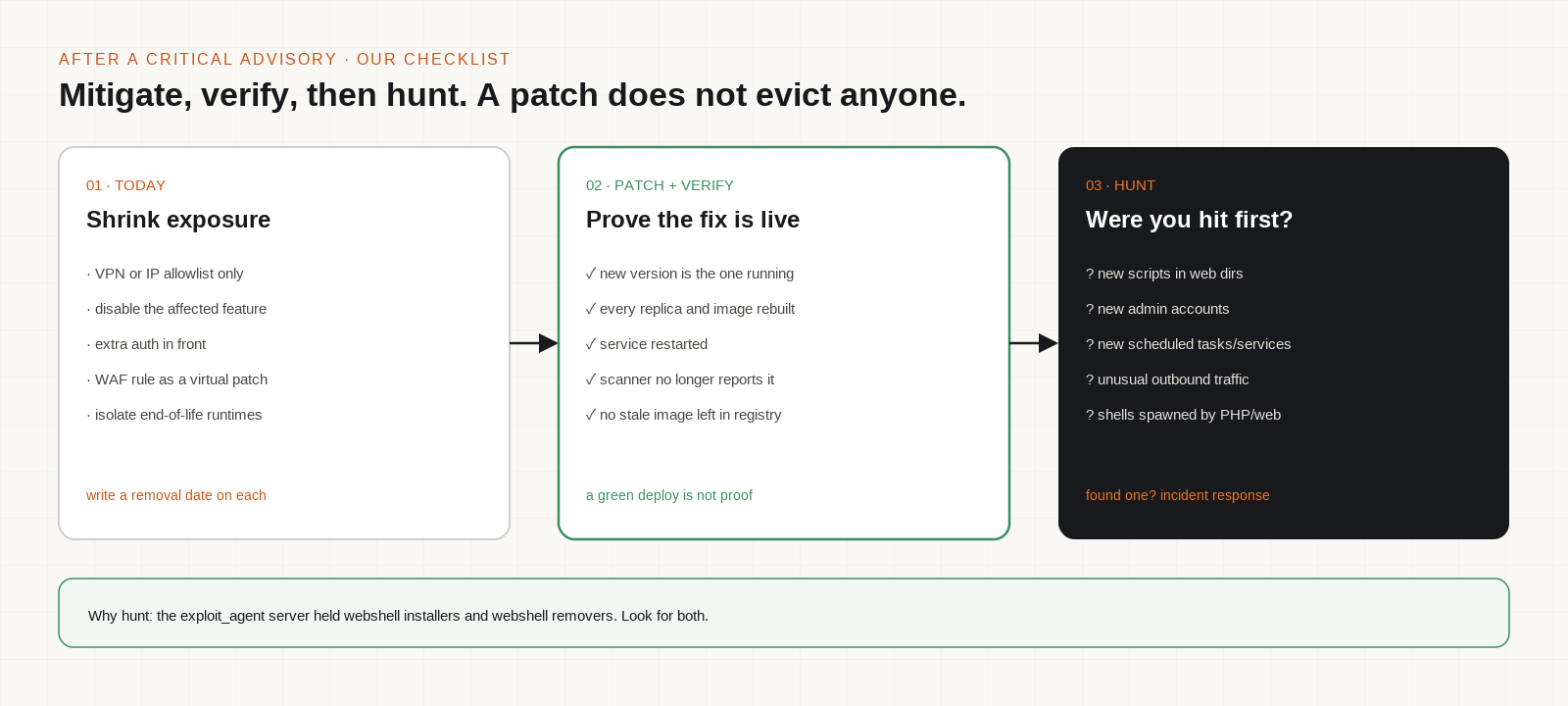
When you cannot patch today, reduce reach today. Restrict the vulnerable service to a VPN or an IP allowlist, disable the affected feature if you can, put an extra authentication layer in front, or add a WAF rule as a virtual patch. These are holding measures. Write down when each one will be removed, or it will stay forever.
After deployment, check that the fix is real: the new version is the one running, every replica and image was rebuilt, the service restarted, and your scanner no longer reports the finding. Deployment status in a dashboard is not proof.
Then assume the worst for anything that was exposed during the window. GTIG found webshell installers and webshell removers on the exploit_agent server, which tells you what to look for: unexpected scripts in web directories, new admin accounts, new scheduled tasks or services, unusual outbound connections and child processes spawned by the web server or PHP. If you find any of these, patching was the first step of incident response, not the end of it.
docker ps --format '{{.Names}}  {{.Image}}'
docker exec your-container php -vfind /var/www -type f -name '*.php' -mtime -14 -printf '%TY-%Tm-%Td %TH:%TM %p\n' 2>/dev/null | sort -r | head -50Tip
On macOS, BSD find has no -printf. Use: find /var/www -type f -name '*.php' -mtime -14 -exec ls -l {} +
Fix 4: for agent builders, separate reasoning from execution
The offensive design gave the model's guess the right to run. Yours should not.
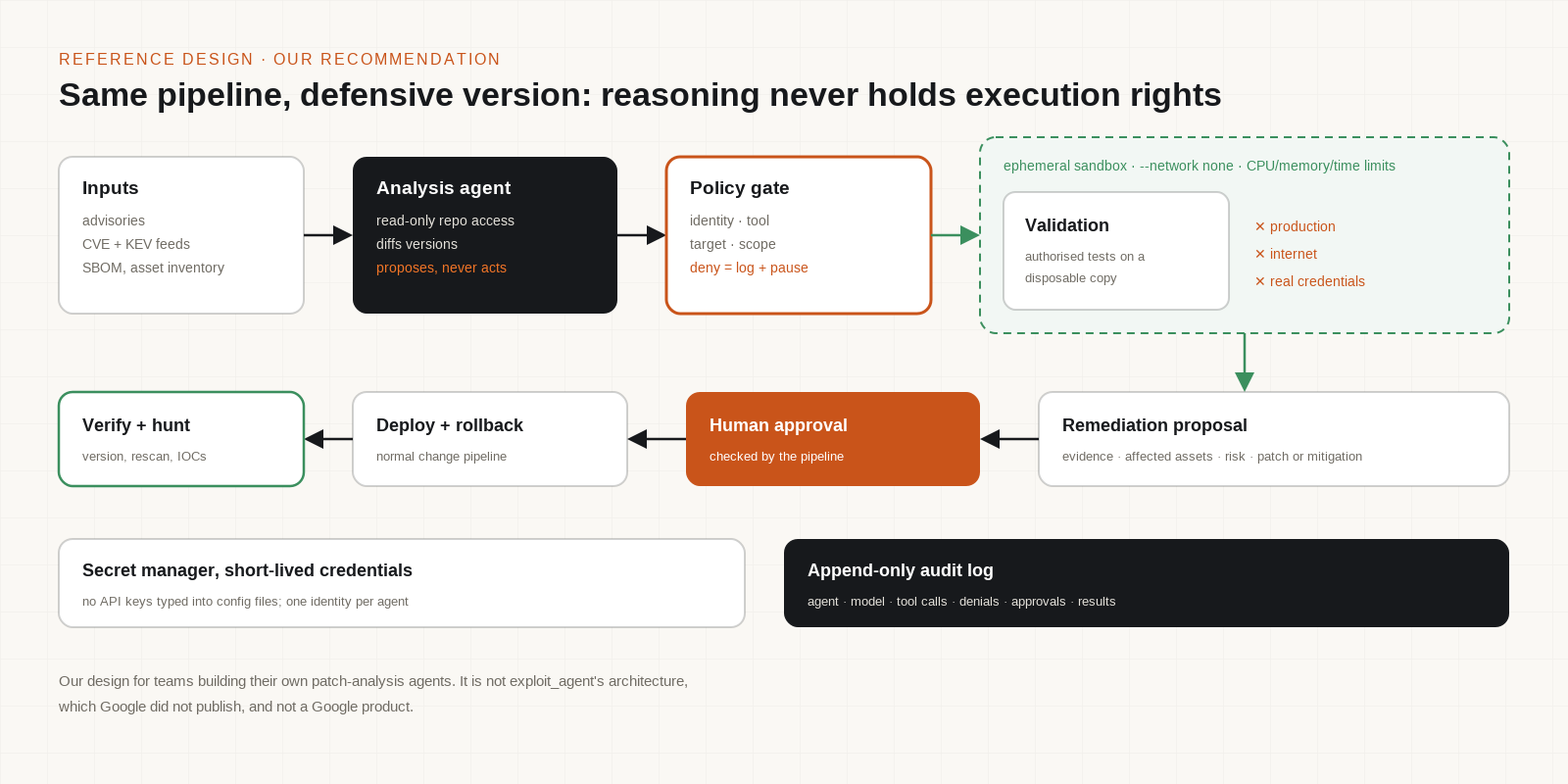
exploit_agent is a useful negative example because its defining property is the one you must not ship: the component that generates code is the same component allowed to execute it, against live targets, without review. If you are building a defensive patch-analysis or coding agent, you will be tempted to wire it the same way because it is faster. Do not.
Split permissions by job. Reading source code, analysing dependencies, running tests, modifying files, deploying and touching production are separate capabilities with separate credentials. An analysis agent gets read-only repository access. A validation agent runs tests only in an ephemeral sandbox. Nothing the model produces reaches production without passing a policy check and, for high-impact actions, a human approval that the pipeline verifies.
Sandbox every execution of generated code: an ephemeral container, no network unless a named destination is required, a read-only filesystem except a scratch directory, resource limits, a hard timeout, and no real credentials. The command below is a starting point.
This design is our recommendation. It follows the OWASP AI Agent Security Cheat Sheet's guidance on least privilege, human approval for high-impact actions and isolation; it is not Google's design or exploit_agent's.
timeout 600 docker run --rm --network none --read-only \
  --tmpfs /tmp:rw,size=256m --memory 2g --cpus 1 --pids-limit 256 \
  --cap-drop ALL --security-opt no-new-privileges \
-v "$PWD/target:/work:ro" your-sandbox-image:1.0 python /work/candidate.pydocker run --rm --name agent-run --network none --read-only `
--tmpfs /tmp:rw,size=256m --memory 2g --cpus 1 --pids-limit 256 `
--cap-drop ALL --security-opt no-new-privileges `
-v "${PWD}/target:/work:ro" your-sandbox-image:1.0 python /work/candidate.pyFix 5: treat agent config, keys and logs as security assets
The attacker's own setup file is the best argument for a secret manager.
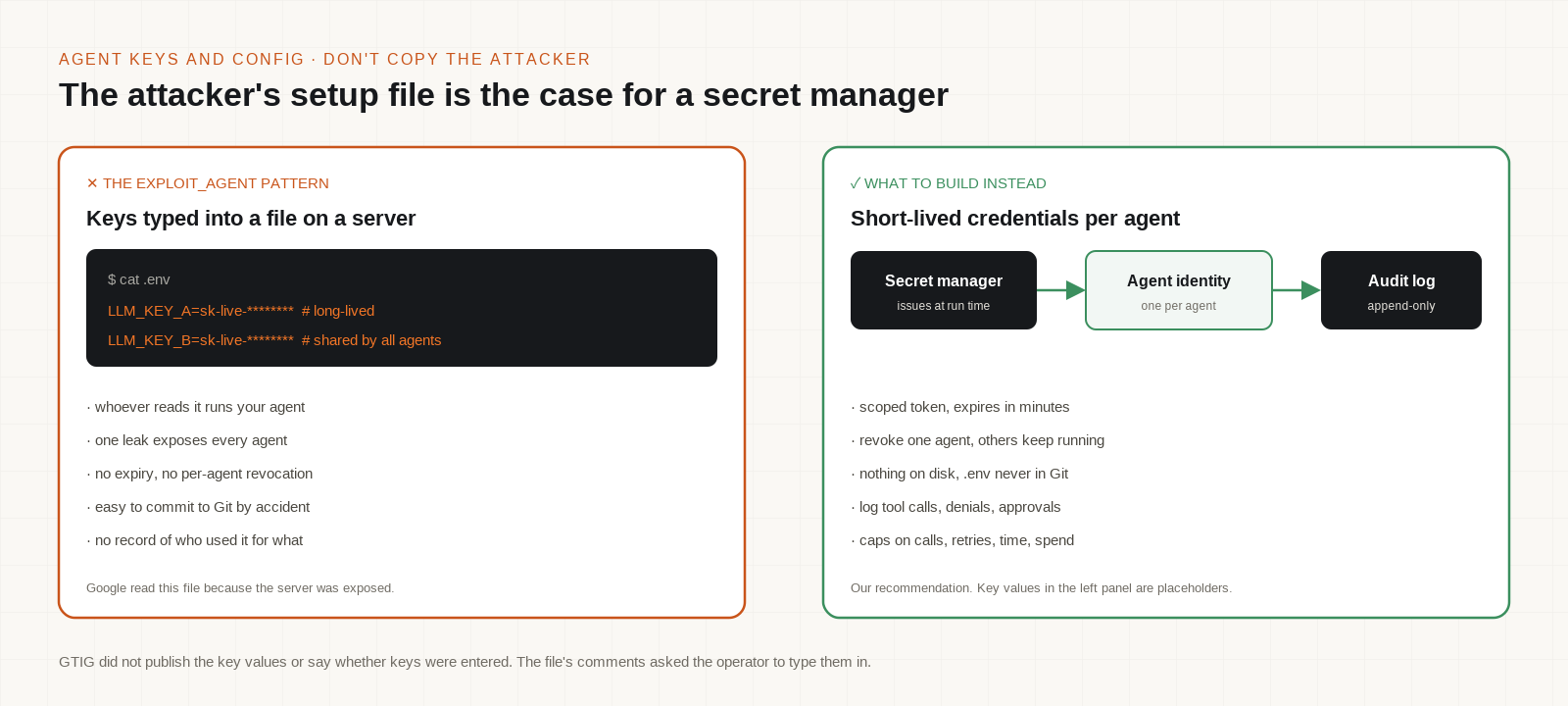
The exploit_agent environment file asked its operator to type LLM API keys straight into it. That file was on an exposed server, and Google read it. Your agent infrastructure carries the same kind of material: model keys, repository tokens, cloud credentials, tool configuration and execution policy. Whoever reads it can run your agent, or a worse one, on your budget and your access.
Keep keys in a managed secret store and inject short-lived credentials at run time. Give each agent its own identity so you can revoke one without stopping the rest. Never commit .env files, scan history for leaked secrets, and rotate any key that has ever sat in a file on a shared or exposed host.
Log what agents do, not just what they say. For each action record the agent identity, model and version, tool call, target, policy decision, approval reference, result and duration, in a store the agent cannot modify. Cap tool calls, retries, run time and spend per session, and alert when a run hits a cap. In a multi-agent system, authenticate agents to each other and validate inter-agent messages, so one compromised agent cannot instruct the rest.
trufflehog git file://. --only-verifiedprintf '.env\n.env.*\n!.env.example\n' >> .gitignore
git rm --cached .env 2>/dev/null; git status --shortWhat the sources confirm, and what they do not
| Claim | Status (checked 17 Nov 2026) |
|---|---|
| GTIG found exploit_agent on an exposed staging server | Confirmed by GTIG |
| It integrates multiple frontier and local LLMs | Confirmed by GTIG |
| It diffs patches, drafts exploits and runs them without human intervention | Confirmed as its configured design |
| Victim data and post-compromise scripts were on the same server | Confirmed by GTIG |
| exploit_agent compromised a named victim | Not stated |
| Success rate, victim count, patch-to-exploit time | Not disclosed |
| Named threat group or nationality | Not attributed |
| exploit_agent ran the PaperCut campaign or exploited PHP2Shell | Not stated; separate cases |
Traditional exploit development vs an agent pipeline
| Traditional | Agent pipeline (as GTIG describes) |
|---|---|
| A person picks a patch worth studying | The system watches popular software continuously |
| A person reads the diff | An agent performs differential analysis |
| A person works out the root cause | An LLM reasons about the change |
| A person writes a proof of concept | An agent drafts exploit candidates |
| A person tests it by hand | The system executes candidates automatically |
| Follow-on work is coordinated manually | Scripts for recon, brute force and webshells sit alongside |
Other agent frameworks in the same GTIG report
- ARTEX: a widely publicised pentesting tool. GTIG says Google SecOps added behavioural and volumetric rule packs to detect its use.
- CAIRN: observed in intrusion activity against targets including the US aerospace sector.
- PentAGI: a customised platform built on the open-source version was used against organisations in Asia between late August and early October 2026.
- CyberStrikeAI and HexStrike AI: GTIG has seen experimentation, not confirmed in-the-wild use.
- None of these is identified as exploit_agent.
This week's checklist
- Inventory: list every internet-facing service with its software version and owner, including runtimes bundled inside vendor products.
- Prioritise: for each open finding, answer CISA's four questions (exposed, in KEV, automatable, control gained) and sort by the answers.
- Emergency path: name who decides, who deploys, who rolls back and who checks for compromise when a critical advisory lands on a Friday night.
- Verify: confirm the running version, rebuilt images and a clean rescan after every security deployment.
- Hunt: check exposed systems for new web scripts, accounts, scheduled tasks and outbound connections from the start of the window.
- Agents: read-only analysis, sandboxed execution with no network, approval for high-impact actions, secrets in a manager, per-agent identities, append-only logs.
Metrics worth tracking
| Metric | Why it matters now |
|---|---|
| Advisory to inventory answer | How fast you know whether you are affected |
| Advisory to mitigation on exposed assets | The real patch window for internet-facing systems |
| Advisory to verified fix | Deployed and confirmed, not just merged |
| Exposed assets triaged for compromise | Share of systems checked for activity before the fix |
| Agent policy denials per run | How often your own agents try to exceed their permissions |
I would not read exploit_agent as proof that AI now hacks the internet on its own. Google found a pipeline designed to do that, on a server that also held victim data, and it published no success rate. That is enough to change two habits. First, I would stop treating patching as scheduled maintenance for anything internet-facing. The PaperCut timeline, advisory to hundreds of victims in about four days, is the planning number I would use, and I would measure our own advisory-to-mitigation time against it. Second, if I were building agents, I would look hard at any place where the model that writes code is also allowed to run it somewhere that matters. That shortcut is exactly what makes exploit_agent dangerous, and it is just as dangerous in a well-meant coding or security agent. Keep the speed of the pipeline, and put a sandbox, a policy gate and a person between the guess and the action.
Frequently asked questions
What is Google's exploit_agent?+
It is the name GTIG gave to a multi-agent vulnerability research and weaponization framework it found on an exposed staging server. It integrates multiple frontier and local LLMs and was set up to diff popular web application software before and after patches, identify likely vulnerabilities, draft exploits and run them without human intervention. It is attacker tooling that Google found, not a Google product.
Did exploit_agent hack real websites?+
Google has not said that a specific exploit from the framework compromised a specific victim. It found exfiltrated victim data and post-compromise scripts on the same server, and victim telemetry pointing at French media, entertainment and education websites, but it published no success rate or victim count.
What is patch diffing?+
Comparing the vulnerable and patched versions of the same software to see what changed. Because security fixes are usually small and targeted, the change often reveals the bug. Defenders can use the same method to understand their exposure to a dependency's security release.
What is the difference between a zero-day and an n-day?+
A zero-day is exploited before defenders have a fix. An n-day is already disclosed or patched, but systems that have not been updated remain vulnerable. Patch-diffing pipelines target n-days, which is why the time between a fix and your deployment matters.
How fast are attackers exploiting new patches?+
In the PaperCut case GTIG cites, researchers built working exploits with LLMs within a day of disclosure, and GreyNoise documented a campaign that reached its first victim about four days after the advisory and went on to hit at least 395 organisations. Google gives no timing for exploit_agent itself.
Who is behind exploit_agent?+
Google does not attribute it to a named group. A configuration file had Russian-language comments, but that alone is not evidence of who operated it.
What should I do first?+
List your internet-facing software and versions, prioritise findings by exposure, active exploitation, automation and impact, patch or restrict exposed systems quickly, verify the fix is running, and check exposed systems for signs of compromise from before the fix. If you build agents, make sure the model that writes code cannot execute it outside a sandbox.